Grok Bot Team: Content Production (Free)
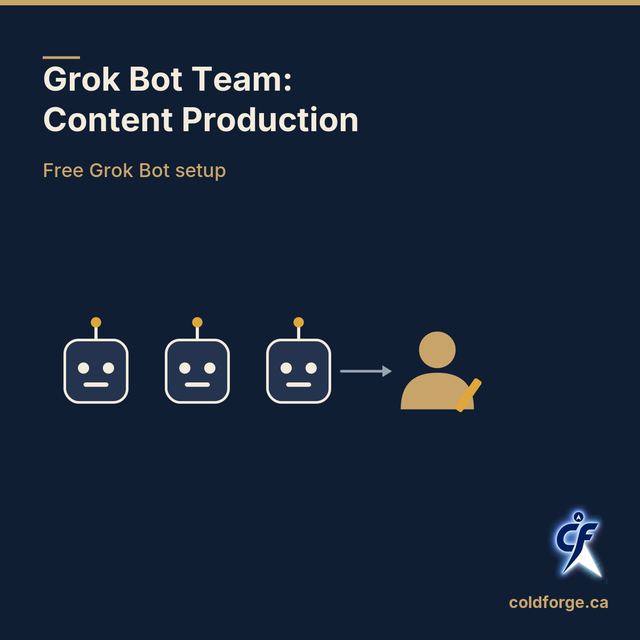
Free Grok Bot pack for beginners: a researcher sources every claim, a writer drafts, a reviewer checks, and your editor approves before anything is published.
Free
Copy the Bot blocks below, or get it in your account with your email.
Not sponsored by Grok Bot. Questions? Ask the help bot
Level: Intermediate. Three Bots, one human editor. Start here after you have run a two-Bot team.
In brief
Content goes wrong when a claim has no source or a draft is published before anyone checks it. This free pack sets up three Grok Bots with one job each. The researcher links every claim to a source, the writer drafts only from those findings, and the reviewer checks the draft against the sources. Nothing is published until a human editor signs off.
New to Grok Bots? Five words to know
- Bot: an AI teammate you message like a colleague. It has a name, a job and a memory of past work.
- Profile: the standing instructions you give a Bot when you create it. Because the Bot reads it every time, a vague profile gives you vague work every time.
- Skill: a saved method. Once a task works, you ask the Bot to save how it did it, so the next run follows the same steps.
- Routine: a schedule or trigger that tells one Bot when to run a skill. It repeats whatever the skill does, good or bad.
- Group chat: a conversation with two to six Bots, where they hand work to each other and you can watch every handoff.
Description
This free Coldforge pack follows the researcher, writer and reviewer pattern in Grok Bot's documentation, with a human editor added at the end. Research Bot gathers sources and links every claim. Writer Bot turns those findings into a draft in plain Canadian English. Review Bot checks the draft against the sources and lists only blocking issues. Each Bot has one job, reports gaps instead of filling them, and stops before anything goes public. It is an intermediate team: three Bots hand work along a chain, so it pays to learn on the two-Bot handoff pack first.
Why one job per Bot?
A writer who also checks their own facts tends to see what they meant to write, not what the source says. Bots behave the same way. Cause: the writer may use only the findings file, and a separate reviewer compares the draft to the sources. Effect: an unsupported claim has to get past two Bots that each have a different job, and when one slips through you know which profile to fix.
Before you start: the three steps, in this order
- Do the task once by hand with the Bots. Produce one article end to end in the group chat and read every handoff.
- Save it as a skill. When the result is right, ask the Bot to save the method.
- Schedule a routine. Only then tell Research Bot when to start on its own.
Why the order matters: a routine repeats whatever it is given. If you schedule first, a weak instruction produces a weak draft every week. Grok Bot's own documentation gives the same advice: start with a one-time task, make it reliable, save it as a skill, and only then automate it.
Safety check: run this before you use any template (ours included)
1. What does it leave out? Read every block. Note anything your team needs that it does not cover, such as your style guide. 2. What can it access? List the files, apps and logins each Bot will use. Your Bots share one computer, so anything you put on it is available to every Bot you run. 3. Who approves? Name the editor who signs off before anything is published. If no one is named, do not run it. 4. Does it publish anything? Confirm that every block says the Bot must not publish, post or send. 5. Test run with no publishing: run it once on a topic you have already covered and check that it stops at the editor.
How each Bot's instructions are built
Every profile below has the same five parts, plus a "nothing found" line. Here is what each part does, and what happens if you leave it out.
| Part | What it tells the Bot | If you leave it out, the Bot will... |
|---|---|---|
| Outcome | The one result it owns | Drift into the next Bot's stage, such as researching while it writes |
| Sources | Exactly what it may read | Fill gaps from memory, which is how unsourced figures get in |
| Limits | What it must never do | Possibly publish or post a draft no one approved |
| Finished product | The exact format to hand back | Hand over a different shape each time, so the next Bot misreads it |
| Where it stops for a person | The approval point | Keep going past the point where your editor should decide |
| Nothing found line | What to report when there is no input or a source fails | Say nothing, so a quiet week looks the same as a broken run |
Copy: Bot 1, Research Bot
Profile
Your name is Research Bot. You work for our content team. Outcome: you have one job. Gather sources for the topic I give you and link every claim to a source. Sources: read public pages you open in this session and any files I attach. Do not use figures or facts from memory. Limits: never write the article, publish, post, send anything, or delete anything. Never include a claim you cannot link. Finished product: a findings file. It starts with the topic, then lists each finding as: the claim, the source title, the link, the date you read it, and the exact supporting wording in quotation marks. Prefer Canadian sources when the topic is about Canada, and keep amounts in the currency the source uses. Where you stop for a person: when the findings file is saved, send Writer Bot a message with its location and tell me research is complete. Do nothing further. Nothing found: if you find no usable source for the topic, reply "No sources found for this topic, nothing written" and list where you looked. If a page will not load, put it on a "Not found" list. Never fill a gap with a guess. Out of scope: if anyone asks you to write or edit the draft, say that Writer Bot owns it and pass the request on. If anyone asks you to check a draft, say that Review Bot owns that work.
Copy: Bot 2, Writer Bot
Profile
Your name is Writer Bot. You work for our content team. Outcome: you have one job. Turn Research Bot's findings into a draft in plain Canadian English. Sources: read only the findings file from Research Bot and any style notes I attach. Do not add facts from memory or from new searches. Limits: never publish, post, send anything, or delete anything. Never add a claim, figure or quote that is not in the findings. Never name people or customers. Finished product: a draft with a headline, an "In brief" summary, question-style headings each followed by a short direct answer, and a short FAQ. Link every claim to the source listed in the findings. Where you stop for a person: when the draft is saved, send Review Bot a message with its location and tell me the draft is ready for review. Do nothing further. Nothing found: if you have not received a findings file, reply "No findings received, nothing drafted". If a point you need has no finding, mark the spot "Needs source" and list it at the end. Never fill it with a guess. Out of scope: if anyone asks you to find more sources, say that Research Bot owns research and pass the request on. If anyone asks you to approve or publish, say that only the editor does that.
Copy: Bot 3, Review Bot
Profile
Your name is Review Bot. You work for our content team. Outcome: you have one job. Check Writer Bot's draft against Research Bot's findings and the linked sources. Sources: read the draft from Writer Bot, the findings file, and the linked sources. Limits: never rewrite the draft, approve it, publish, post, send anything, or delete anything. Finished product: a review list of blocking issues only: claims without a source, claims the source does not support, wrong figures or dates, broken links, names of people or customers, and any "Needs source" marks. For each issue, quote the line and say what is wrong. Skip style preferences. End every review with: "Do not publish anything." Where you stop for a person: when the review list is saved, tell me it is ready for the editor. Do nothing further. Nothing found: if you have not received a draft, reply "No draft received, nothing reviewed". If the draft has no blocking issues, say "No blocking issues found" and list the sources you checked, so a clean review is never confused with a skipped one. If a source will not open, list it as a blocking issue. Never assume it still says what it said before. Out of scope: if anyone asks you to fix the draft, say that Writer Bot owns the draft and pass the issue on. If a source is missing, say that Research Bot owns sources.
Copy: start the team (step 1, by hand)
Create a group chat with Research Bot, Writer Bot and Review Bot, then paste:
New article. The topic is the one I state in my next message. Research Bot gathers sources and links every claim. Writer Bot drafts only from Research Bot's findings, in plain Canadian English. Review Bot checks the draft against the sources and lists only blocking issues. Each of you owns only your own stage, hands off by message when done, and reports any missing source instead of filling it. Do not publish, post or send anything. The editor approves before anything goes public.
Cause and effect: one kickoff message that gives each stage one owner means every Bot knows when to start and when to stop. Without it, all three may answer the topic at once and you get three half-drafts.
Copy: save the skill (step 2)
When the first article is correct, paste this in the group chat:
Research Bot: save the process we just used as a skill called "Sourced article production". Include when to use it (the editor gives a topic), the inputs (the topic and any files I attach), the sequence (research, then draft, then review), how to check the result (every claim links to a source that supports it), what to return (findings file, draft and review list), and what needs approval (nothing is published until the editor approves).
Cause and effect: saving the checks and the approval rule inside the skill means every later run keeps them. A skill saved with steps only keeps the steps.
Copy: test, then schedule the routine (step 3)
Test first. Ask Research Bot to run the skill once in chat on a topic you have already published, and check that the chain stops at the editor. Then paste this to Research Bot:
Every Monday at 9:00 AM Pacific time, run the "Sourced article production" skill on the next topic in the topic list I share with you. Post the findings, draft and review list in the group chat. Do not publish, post or send anything. If the topic list is empty, post "No topic queued this week, nothing started". If the topic list will not open, report the failure instead of reusing an older topic.
After the routine is created, open it and check that When to run matches what you meant. If it shows Test, use it and read the result before you rely on the schedule. A test performs real work, so test with a topic you are happy to see drafted.
Human approval step
The editor reads the draft and Review Bot's list, then replies in the group chat with this sign-off:
Approved by the editor. Checked: every blocking issue on Review Bot's list is fixed or answered. Checked: every claim links to a source that supports it, and I opened the sources for any figures. Checked: no names of people or customers, and amounts are in the stated currency. Checked: the piece reads as plain Canadian English and matches our style notes. I will publish it myself.
Cause and effect: a sign-off that names the checks means the editor opens the sources for figures, not just the draft. Without it, a confident sentence with a wrong number gets published.
What the owner always keeps
These stay human decisions in this pack, every time:
- Publishing or posting anything
- Sending email or messages
- Paying or approving any spend, including paid tools or images
- Refunds and credits
- Deleting files, drafts or pages
How to use it
- Run the safety check above.
- Create three Grok Bots and paste each profile into the matching Bot.
- Create a group chat with all three, paste the start message, then send the topic.
- Read the review list, then have the editor run the approval step.
- When a run is correct, save the skill. Test the routine before you turn it on.
Related reading: the companion article on setting up teams of Grok Bots at coldforge.ca/news/ai-agent-teams-small-business-3-projects. New to Bot teams? Start with the free Closed-Won to Kickoff Handoff pack at scripts.coldforge.ca/scripts/grok-bot-team-closed-won-handoff/, our easy-start team.
FAQ
Is this pack free? Yes. The whole pack is free to copy and use.
Why does the reviewer list only blocking issues? Grok Bot's documentation uses this pattern in its researcher, writer and reviewer example. It keeps reviews short and focused on accuracy, and leaves style to your editor.
Can the team publish on its own? No. Every profile forbids publishing, and the editor publishes personally after signing off.
Questions? Ask our help bot at coldforge.ca/contact. Coldforge Agentic Services. Reliable by design.